

Our Shop
Your source for thoughtfully designed gear and essential professional resources created especially for play therapists, students, and licensed clinicians. Designed and provided by the Oklahoma Play Therapy Training Institute.

Continuing Education Book Tests
Non-Contact APT-Approved Continuing Education: Book Tests
APT Approved Provider # 17-491
Welcome to our Non-Contact Continuing Education page, where you can earn APT-approved Non-Contact CEs by completing book-based learning assessments. These courses are designed for play therapists and mental health professionals who want high-quality, flexible continuing education options that fit their schedule.
Our book tests allow you to deepen your knowledge, demonstrate competence in key play therapy concepts, and receive credit—all at your own pace.
Who This Is For
These book tests are designed for:
-
Registered Play Therapists and RPT-S seeking APT-approved Non-Contact CEs
-
Mental health professionals expanding their play therapy knowledge
-
Clinicians wanting flexible, self-paced CE options
Course Format & Policies
-
All courses are APT-approved for Non-Contact hours.
-
Tests must be completed independently.
-
Certificates are automatically issued upon successful completion of test and evaluation.
-
All sales are final due to the digital nature of the coursework.
View Available Tests Below!
How It Works
1. Select a Book Test
Choose from our growing library of APT-approved book-based courses.
2. Purchase & Read the Book
You may use your own copy of the book. Books are not included in course registration.
3. Purchase and Complete the Test
After reading, complete the online test covering core concepts, applications, and learning objectives. Send a request and an invoice will be sent to you. After purchase, the test link will be sent.
4. Complete Evaluation and Receive Your Certificate
A passing score of 80% or higher is required. Once completed, you’ll receive an evaluation. An APT-approved Non-Contact CE certificate will auto-generate upon completion of the evaluation for your records.
Current Available Tests
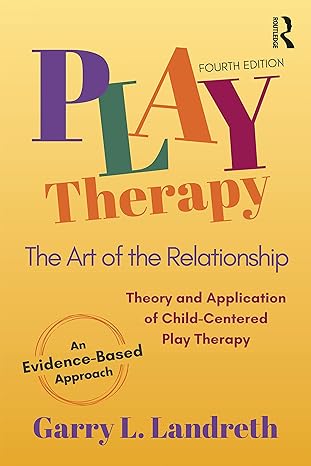
Landreth, G. L. (2023). Play therapy: The art of relationship (4th ed.). Routledge/Taylor & Francis Group.
10 Non-Contact CEs: Cost: $100
Course Description:
Considered a foundational book in the field of Child-Centered Play Therapy, “The Art of the Relationship” by Garry Landreth considers the power and purpose of the use of play in the clinical arena. Originally published in 1991, the book is now in its’ 4th edition. Landreth begins by exploring the meaning of play and the history of the field of play therapy. The book then moves into the theoretical basis of Child-Centered Play Therapy and dives deeper to the intricacies of implementing the theory in practice.
Learning Objectives
1. Describe 3 or more ways play bridges the gap between abstract and concrete experiences for children.
2. Identify the 9 major development stages in the history of play therapy according to the book.
3. Explore the 10 tenets for relating to children from a child-centered framework.
4. Analyze 3 or more ways personality theory informs the field of Child-Centered Play Therapy.
5. Explore the 8 basic principles of the nature of the child-therapist relationship defined by Virginia Axline.
6. Describe 3 or more ways Child-Centered Play Therapy encourages cultural responsiveness in its approach.
7. Identify 3 or more of the intangibles in the play therapy relationship.
8.Describe 3 or more components of the playroom and materials used.
9. Explore 3 or more basic guidelines in therapeutic limit setting.
10. Analyze 3 or more research studies in Child-Centered Play Therapy using randomized controlled studies.
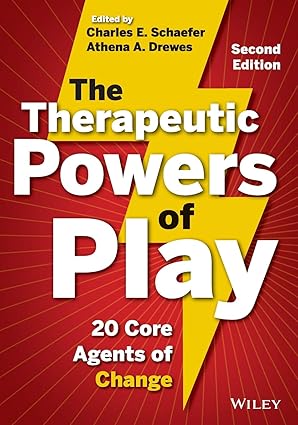
Schaefer, C. E., & Drewes, A. A. (Eds.). (2014). The therapeutic powers of play: 20 core agents of change (2nd ed.). Wiley.
9 Non-Contact CEs: Cost: $90
Course Description:
Considered a foundational book in the field of play therapy, The Therapeutic Powers of Play, Second Edition, explores the powerful effects that play therapy has on different areas within a child or adolescent’s life: communication, emotion regulation, relationship enhancement, and personal strengths. Editors Charles Schaefer and Athena Drewes – renowned experts in the field of play therapy – discuss the different interventions and components of treatment that can move clients to change.
Learning Objectives
1. Define the major therapeutic powers of play and their role in child development and healing.
2. Identify the ways play therapy supports the integration of implicit and explicit memories.
3. Discuss how play therapy fosters emotional regulation, problem-solving, and coping strategies.
4. Illustrate how guided practice, modeling, and reinforcement enhance skill acquisition in play therapy.
5. Assess the impact of therapeutic play on neural organization and relational behaviors.
6. Compare the roles of free play and structured play in therapeutic interventions.
7. Demonstrate an understanding of how play therapy provides psychological distance for children to express emotions safely.
8. Interpret the role of optimal “distancing” in helping clients process traumatic events while maintaining emotional safety.
9. Apply knowledge of the therapeutic powers of play to case examples involving children with emotional or behavioral challenges.
10. Explain the importance of therapeutic alliance in maximizing the effectiveness of play interventions.
11. Analyze the connection between play therapy and neurobiological processes involved in emotional healing.
12. Describe how play therapy facilitates self-expression and emotional communication in children.
More Book Tests Coming Soon!
We will be adding additional book-based CE options in the near future to help you continue growing as a play therapist. Check back regularly or join our mailing list to be notified when new courses are added.
Contact the Training Institute
Need to get in touch? Have a question? Fill in the form below and Nancy will get back with you to answer any questions you may have. Feel free to contact them as well at (405) 413-4768.
"*" indicates required fields

Oklahoma Play Therapy Training Institute
(405) 413-4768
oklahomaplaytherapy@gmail.com
10400 N. Vineyard, Suite C
Oklahoma City, OK 73120

It is the policy of FSC Kids to treat all clients and not to discriminate with regard to race, color, religion, national origin, age, sex, sexual orientation, gender identity or expression, or disability.